22 September 2013

Hollywoodisation

Oxford Dictionaries online defines Hollywoodisation as a “[conformity] to the supposed norms of a typical Hollywood film, especially in respect of being unrealistically glamorous, exciting, or simplistic” (2013). I find it rather interesting how they note that it is “unrealistically glamorous” when a greater part of Hollywood’s actors and actresses are expected to constantly portray themselves as glamorous.

According to Christina Klein (2004), Hollywood, “in many ways, is no longer an American film industry” (p.371). In regards to this, it should be important to realise that Hollywood has now become, what I believe, a stigma.
Firstly, I’d like to note that in addition to what Klein observed, she also notes that, Hollywood “remains heavily dependent on overseas audiences” (2004, p.363) to which she continues to explain that it is important to pay close mind to the “complex nature of cultural globalisation by looking at the diverse ways...[that] it is experienced in particular instances” (p.362).

For this post, I will be discussing the plastic surgery procedures that are becoming highly popular in South Korea, where full facial reconstructions are undertaken to appear more Western than that of their Asian heritage.
In conjunction with Klein, Frederick Wasser (1995) explores transnationalism, where “various institutions are promoted or destroyed by the export surplus of American mass media” (p.245). American mass media does include Hollywood, of which includes the appearance of Hollywood actors and actresses, in which South Korean’s are increasingly changing their appearance to suit the Western image; one in five South Korean women have had some form of plastic surgery in comparison to one in twenty Americans. Furthermore, Wasser continues to note that the “extent to which an international audience adopts American values [is] because of the increased exposure to American mass media” (1995, p.245).

The K-Pop industry is notorious for containing the visual facial appearance of a more Western look.
Firstly, these are a few before and after images (that I think are the most extreme):


This is a K-Pop video:
 

As the images and video show, the faces do appear more Western through bigger eyes, with a double eye-lid, leaner faces (pointy chins) and even the fashion is “unrealistically glamorous”, with suits that are highly Hollywood-esque.

I believe there is a new-found obsession with wanting to appear more Western that  was driven from Hollywoodisation.
 
 
References:
Klein, Christina 2004, ‘Martial arts and globalisation of US and Asian film industries’, Comparative America Studies, vol. 2, no. 3, pp. 360-384. 
Man Man Ha Ni - U-KISS MV 2009, Youtube, MrSommi, 26 November, retrieved 22 September 2013, <https://www.youtube.com/watch?v=zx8xNJ5Ow-w>
Oxford University Press, 2013, ‘Oxford Dictionaries’, retrieved 22 September 2013, <http://oxforddictionaries.com/definition/english/Hollywoodize>  
Wasser, Frederick 1995, ‘Is Hollywood America? The Trans-nationalization of the American Film Industry’ Critical Studies in Mass Communication. Vol 12. Pp423-437.
Wright-Ruiz, K 2013, ‘BuzzFeed Community’, retrieved 22 September 2013, <http://www.buzzfeed.com/kierawrr/31-crazy-before-and-after-photos-of-korean-plastic-4gx1>

14 September 2013

Photoshopping my Specular Economy

Defined by David Marshall (2010), the Specular Economy is where “we are becoming more conscious of how we present ourselves and how others perceive us” (p.498-99). Regarding this day and age, I believe this rings true to majority of the social media users – myself included.

I use a few social media sites, of which include Facebook, Tumblr, Twitter (rarely, if not ever) and now Blogger. That’s quite a bit considering they all in some way demonstrate a view of myself.

However, when it comes to Facebook especially, I am incredibly aware of the types of images I upload of myself. Marshall (2010) notes that we currently have a “complex presentation of the self” (p.499) where I do believe we are becoming more aware, through outside influences and celebrities, of how we put ourselves out there in regard to appearance. We create our own “persona” that is from our mobile media screen's, acting as a mirror that is thought to produce someones persona (Marshall 2010, p.499).

This is interesting because I consider a person who carries out a ‘selfie’ creates their own persona in regard to what kind of selfie they take. For example, Marshall (2010) explains that online, we move into a “quasi-public presentation of ourselves” that essentially is a mediated version of ourselves (p.499).  According to Urban Dictionary, a selfie is:

What I find rather important to illustrate first is that Marshall observes that, through looking in a mirror and trying to imagine a better version of ourselves, we try to achieve this “through our activities and technique” (p.499) of which my 'selfie' demonstrates techniques from photoshopping and photo-editing.

I admit, I do take a selfie and put it up on Facebook as my display picture, and I also admit that I do edit them so they appear blemish free. I am highly aware at who will see the picture so naturally I try to increase the value of the appearance by photoshopping out my bad skin days and adding some extra’s like brightness or exposures – even sometimes lighting flares – just so it will appear more inviting than what the original selfie looked like.

For example:


To some degree, my online persona is a photo-editing junkie that gives off some falseness, but essentially, I just want to appear ‘pretty’ to online social media sites (as pretentious as that may be).


References:
Marshal, P.D 2010, ‘The Specular Economy’, Society, vol. 47, no. 6, pp. 498-502
Images: Authors own
Urban Dictionary, 1999-2013, ‘Urban Dictionary’, retrieved 13 September 2013, <http://www.urbandictionary.com/define.php?term=selfie>

8 September 2013

Instagram - Participatory Media Culture

I thought I would stick to what my url promises and incorporate photoglobalisation into this weeks blog on participatory media.
According to Joost Raessens (2005, p.373), “participatory media culture is not limited to cultural forms such as computer games”, thus is a broad concept that includes various forms of media that allows a person to participate in. However, Raessens also notes that “the view that participation is a new, exclusive, and essential characteristic of computer games ignores the fact that radio, film and television, for example, each have their own versions of this concept” (2005, p. 372). This implies that participatory media culture varies with each form of media. 
Within Raessens article, he notes that computer games follow “specific characteristics or principles...as a form of digital media” of which include, multimediality, virtuality, interactivity and connectivity (2005, p.374) though this is not limited to computer games and does include most other media outlets.
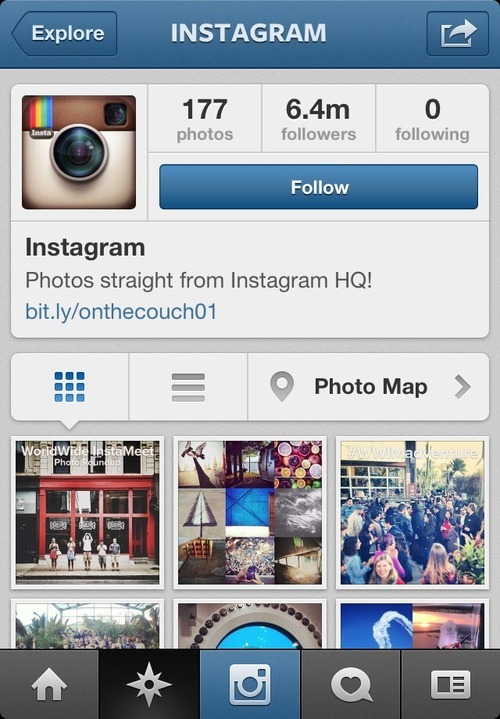
In regards to this week’s topic, the non-game participatory media culture I chose to demonstrate is Instagram, specifically linking Raessens connectivity element. Raessens observes that connectivity allows the “ability to exchange ideas, knowledge...amongst each other via the internet” (p.374) to which I considered Instagram.
Instagram is a mobile app that is allows a user to take a picture and edit it before instantly sharing it on the Instagram network. Furthermore, the images “can be shared on other social networks, as well, including Twitter, Facebook, Tumblr, Flickr, and Foursquare” (Salomon, 2013) which demonstrates what Raessens noted on connectivity.


Image: Screen Shots
(Instagram.com/web.stagram.com)

Instagram, as can be seen, is a network that is available both on a mobile device and online (however, the internet addresses are unable to upload images though can make comments). This displays a significant connectivity because a user is not limited to their mobile device. For example, I rely heavily on the online sites, because Blackberries do not cater to the Instagram app, and the only way I can make comments and see the updates is through the online websites.
This virtual world, though not associated with gaming, demonstrates a similar idea because the connectivity that Raessens describes can be seen through Instagram. Take for example Instagram user SydneyFashionBlogger who achieved her 330K+ followers because they connected with her ideals about fashion, who then, by a virtual ‘word-of-mouth’, has become a fashion guru to some followers.

References:
Raessens, J. 2005, ‘Computer games as participatory media culture’, Handbook of Computer Game Studies, MIT Press, Cambridge, Mass, pp. 373-388
Salomon, D 2013, ‘Moving on from Facebook: Using Instagram to connect with undergraduates and engage in teaching and learning’, College & Research Libraries News,
vol. 74, no.8, retrieved 8 September 2013. <http://crln.acrl.org/content/74/8/408.full>

Instagram Inc, 2012, 'Instagram 3.0 - Photo Maps & More', retrieved 8 September 2013, <http//blog.instagram.com/post/29555443184/instagram-3-0-photo-maps-more-weve-been>
Images: Instagram.com
               web.stagram.com

2 September 2013

Political Innovation – Blogosphere

With the increasing use of the internet and its increasing prevalence within our everyday lives, it would be rather detrimental if politics didn't include themselves within the sphere of 'blogging'. Not only does this form bring global recognition but more importantly – with this specific post – blogs are becoming a vehicle that produces a new communication sphere that does include political commentaries (Lim 2012, p.128).

The internet, specifically Web 2.0 (Bruns et al. 2011; Ritzer & Jurgenson 2010), is an innovative, non-traditional media form that appeals to the ‘internet generation’ (McCrindle, p.19). For example, Twitter has become a political platform that is used globally on a wide scale and is also used by people of various ages. More clearly, Twitter is seen as a ‘microblog’, being a “derivative or miniature version of a regular blog” because of its use of short comments (Larsson & Moe 2012, p.730).

This topic is quite important right now considering the campaigning for the Australian Election that is being held this week. Both the Liberal and Labor parties are making use of Twitter for their campaigns. According to Larsson and Moe (2012), blogs are essentially used as a “campaign gimmick” (p.732) but also as a means to engage with the wider public to “disseminate information” (p.732-33) given that Twitter only allows for 140 characters in its text box.

Aside from that, political blogging with Twitter as its media form provides “new opportunities for online campaigning and electorate engagement” (Larsson & Moe 2012, p. 730). This statement implies that the running leaders, for example, are embracing a new media form that fundamentally allows a broad scope of acknowledgement nationally.

Both the Labor and Liberal parties utilise Twitter to supply information about where they are, what they’re doing as well as information about their policies, tolls and what they aspire to contribute for the future.
Image Courtesy: Twitter

 Image Courtesy: Twitter

Moreover, through political blogging, particularly through Twitter, it enhances the citizens’ contribution with “political participation” (Lim 2012, p.129) as they are able to directly ‘tweet’ either opposition with their distinct thoughts. It’s a very valuable form of information because it especially appeals to a generation that is incredibly dependent on the internet. Political blogging provides a sense of humanity (I believe) because as citizens we're being given information that is coming straight from the sources (by their individual accounts).


References


Bruns A, Burgess J, Highfield T, Kirchhoff L and Nicolai T 2011, ‘Mapping the Australian Networked Public Sphere’, Social Science Computer Review, vol. 29, no. 3, pp. 277-87

Images: Screen shots of Twitter pages put together


Larsson A O, Moe H 2012, ‘Studying political microblogging: Twitter users in the 2010 Swedish election campaign’, New Media Society, vol. 14, no. 5, pp. 729-47


Lim, M 2012, ‘Life is Local in the Imagined Global Community: Islam and Politics in the Indonesian Blogosphere’, Journal of Media and Religion, vol. 11, no. 3, pp. 127-40

McCrindle, Seriously Cool: Marketing and Communicating with diverse generations, p.19

Ritzer G, Jurgenson N 2010, 'Production, Consumption, Prosumption: The nature of capitalism in the age of the digital 'prosumer'', Journal of Consumer Culture, vol. 10 no. 1, pp. 13-36